The following is not my text - comes from my news feed - just going by that this idea seems to be heating up .... who knows?
Add to this there are posters who think that Saskatchewan and eventually BC will join in ......
***************************************************************************************************************************************************************
Myth: “Alberta could never survive as an independent country. You’re landlocked. You’ll never get your oil to market.”
That argument sounds strong - until you actually look at the leverage Alberta already holds.
Right now, Alberta is landlocked in two ways:
Geography
Policy
We can’t change geography.
But policy? That’s entirely different.
Under Ottawa, Alberta is landlocked by federal laws, regulatory delays, political ideology, and governments openly hostile to resource development. Even when projects are economically viable, nationally beneficial, and globally strategic, they’re blocked, delayed, or strangled in red tape.
That’s policy landlocking.
Independence removes that barrier overnight.
And here’s what most critics ignore:
Alberta isn’t powerless in the geography equation either.
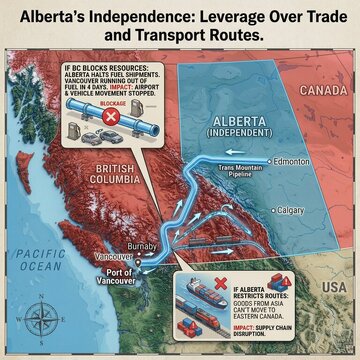
Take British Columbia.
People say, “BC would never let Alberta ship oil through their province.”
Reality check:
The Lower Mainland runs on Alberta fuel.
The Trans Mountain pipeline feeds the Burnaby refinery. That refinery supplies gasoline, diesel, jet fuel - the lifeblood of Vancouver’s economy.
If Alberta fuel stopped flowing, the Lower Mainland would face shortages in roughly four days.
Airports.
Trucking.
Gas stations.
Emergency services.
This isn’t a threat. It’s economic interdependence.
BC needs Alberta energy just as much as Alberta needs Pacific access.
That’s not weakness.
That’s leverage.
Now zoom out.
The Port of Vancouver is Canada’s primary gateway to Asia. The majority of container traffic from Asia lands there and moves east by rail - through the West.
If Alberta were independent and negotiations turned hostile, Canada would suddenly face its own geographic reality:
Trade corridors are mutual.
Energy corridors are mutual.
Rail corridors are mutual.
You don’t get to say “no pipelines” while expecting uninterrupted access to ports, rail, fuel, and infrastructure.
That’s not how sovereign trade negotiations work.
Independence doesn’t isolate Alberta.
It flips the negotiating table.
Instead of pleading with Ottawa to approve infrastructure, Alberta would negotiate directly - as a sovereign energy producer that:
• Supplies fuel to western Canada
• Hosts critical rail corridors
• Produces globally demanded commodities
• Sits between Pacific ports and eastern markets
• Has the economic capacity to expand export infrastructure rapidly
The biggest shift isn’t geography.
It’s bargaining power.
Inside Canada, Alberta has limited leverage. Federal governments can ignore us because political incentives reward blocking development.
As an independent nation, Alberta would negotiate trade access from a position of strength, backed by:
• Energy security leverage
• Transit corridor leverage
• Continental trade relationships with the United States
• Strong fiscal capacity
• Global demand for oil, gas, agriculture, petrochemicals, and critical minerals
And here’s the part critics never address:
Markets want Alberta energy.
The constraint isn’t demand.
It’s federal obstruction.
Independence removes policy landlocking and replaces it with sovereign decision-making.
Would negotiations be tough? Of course.
But the idea that Alberta would have less leverage outside Canada is simply wrong.
Right now we’re landlocked by ideology.
Independence removes that barrier and turns Alberta from a politically constrained province into a strategic energy state negotiating as an equal.
We don’t lose leverage.
We gain it.