


trainedobserver
Paranormally Disenchanted
This the only photograph of a possible X-Drone that I've uncovered. Note that this was published years before G. Leonard's book.
FLYING SAUCERS-SERIOUS BUSINESS-FRANK EDWARDS
page. 202
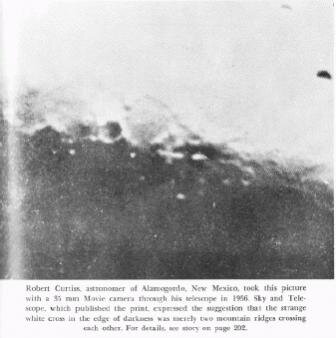
Robert E. Curtiss of Alamogordo, New Mexico, is not
only a very capable astronomer, he is also a skilled photographer.
On the night of November 26, 1956, Mr. Curtiss was
making some test shots with a Mitchell 35 millimeter
motion picture camera. It was loaded with highly sensitized
film and was coupled to the rangefinder of his l6-inch
reflector telescope. With this setup he was able to shoot
pictures of the moon at speeds of 24 to 48 frames per
second. The telescope was covering that portion of thc
moon around Fra Mauro, which lies between Parry ancl
Copernicus.
When Mr. Curtiss developed and printed his films he
was startled by a peculiarity. Just to the left of the terminator,
which is the dividing line between sunlight ancl
shadow on the moon, there was a small white Mal tes
cross. ft was on frame after frame and was unquestionably
either on the surface of the moon or very close to it.
Sxv AND TrrnscopE ran the picture in June of l95tl.
They appended a suggestion by Walter Ffaas, I)irector o[
the Association of Lunar and Planetary Observers, wlro
ventured the possibility that the strange white cross wit6
the four arms of equal length might be only a group ,l'
ridges or mountain spurs, visible in this particular lorrrr
only for a fleeting period when the sunlight reaches rlrr:
lower slopes.
It is an interesting theory. Unfortunately it conflir:ts
with nature. For ridges or mountain spurs to cross caltr
other at right angles is a physical impossibility, accor(lirrg
to the LJ.S. Geodetic Survey, since the forces that crcltt.rl
one ridge would automatically destroy the other.
The cross was there. Mr. Curtiss photographed it. Tlrrrs
far, it seems, ro one has been able to explain it.
FLYING SAUCERS-SERIOUS BUSINESS-FRANK EDWARDS
page. 202
Robert E. Curtiss of Alamogordo, New Mexico, is not
only a very capable astronomer, he is also a skilled photographer.
On the night of November 26, 1956, Mr. Curtiss was
making some test shots with a Mitchell 35 millimeter
motion picture camera. It was loaded with highly sensitized
film and was coupled to the rangefinder of his l6-inch
reflector telescope. With this setup he was able to shoot
pictures of the moon at speeds of 24 to 48 frames per
second. The telescope was covering that portion of thc
moon around Fra Mauro, which lies between Parry ancl
Copernicus.
When Mr. Curtiss developed and printed his films he
was startled by a peculiarity. Just to the left of the terminator,
which is the dividing line between sunlight ancl
shadow on the moon, there was a small white Mal tes
cross. ft was on frame after frame and was unquestionably
either on the surface of the moon or very close to it.
Sxv AND TrrnscopE ran the picture in June of l95tl.
They appended a suggestion by Walter Ffaas, I)irector o[
the Association of Lunar and Planetary Observers, wlro
ventured the possibility that the strange white cross wit6
the four arms of equal length might be only a group ,l'
ridges or mountain spurs, visible in this particular lorrrr
only for a fleeting period when the sunlight reaches rlrr:
lower slopes.
It is an interesting theory. Unfortunately it conflir:ts
with nature. For ridges or mountain spurs to cross caltr
other at right angles is a physical impossibility, accor(lirrg
to the LJ.S. Geodetic Survey, since the forces that crcltt.rl
one ridge would automatically destroy the other.
The cross was there. Mr. Curtiss photographed it. Tlrrrs
far, it seems, ro one has been able to explain it.