Since I have some passing acquaintance with (personality) graphology I want to focus on the 'rebuttal' given by Budd Hopkins in one of Sean Meers' links. In doing this I am not presenting myself as an authority in the least. I am an amateur in personality graphology (the pseudoscience).

That, of course, gives me no standing whatsoever, except to say, that I have a passing interest in analyzing handwriting, and have analyzed a bit over the years 'for fun'. I am not a forensic graphologist.
Budd Hopkins states:
"The well-known, reliable investigator Don Ledger posted the following on UFO Updates on March 7:"
I wish to draw your attention to the fact that no matter how 'reliable' an investigator Mr Ledger may be, he is making his assessment based on what he sees in Carol Rainey's video.

Yet, Mr Ledger posits his interpretation as superior to Mr Rubin, who was the forensic graphologist who had the documents in front of him and had done an in-person analysis. Right here we are on shaky ground with anything Mr Ledger might suggest as pre-empting the in-person investigator. He openly states: "
I note the following from observing the video:"
“What I saw did not convince me, Carol. In fact, if anything I question your expert."
Pretty cheeky, given that he did not have the extensive exemplars of Linda's writing in front of him as did Rubin, who also likely had hours - potentially across days - to view and study the exemplars and make the comparison.
Then there is this -
You have the two different Budd Hopkins written in each case and not only in my estimation did the 'Hs" or 2s not match but identical letters in the names - either before or after - didn't come close to matching.
I defy anyone not to be amazed at the similarity of the '2' s. The similarity of the '2' s is the seal - given everything else. Even for Rubin, as he says, the '2' did it - same person wrote both samples. The probability of two random people making similar 2's like this, right down to the down stroke, is very, very low - but add to that the 'H' s (and other elements) - and the probability is further impacted.
Rubin was doing a
forensic analysis and the similarity between the two samples is significant. Ledger states: "
H: Linda starts with a straight downstroke for the first line of the H. Janet starts with a curved line going down and then up leading to the top of the downstroke for the first line of the H. The downward slant in the middle of the H is common and is not idiosyncratic. Linda's and Janet's H s are not virtually identical as Rubin states."
This is slightly off as I see it: Janet's H starts with a single up-stroke, then a down stroke. Linda's starts with a single downstroke. In terms of forensic graphology this difference is not significant (apparently) or when working with the larger sample. However, in
personality graphology (the pseudoscience) it is significant: as the lead-in stroke suggests 'planning' and deliberate forethought (what one would expect with the envelope writer - who could
potentially have been trying to mask their writing) but not necessarily with the H in a quickly penned letter. Rubin was looking at about 6 to 7 pages of Linda's handwriting, so we can assume that he had a good handle on her H formation. Mr Ledger did not have that largesse of sample.
What Rudin points out is the strange curve in the second stroke - idiosyncratic to both samples - and remember he is deciding what we see as he is choosing from the larger 'Linda sample' to show us what drives his conclusions. In fact, what I see there is an unusual - and yes, idiosyncratic - 'underlooping' of the H's crossbar. To find this in two (apparently random) samples being compared is also unusual. Not only are we seeing one element similar - but because it is a
forensic analysis that has to do (in part) with the sum total of 'coincidences' - we are being shown several elements that, taken as a whole, point to a conclusion. The forensic examiner is trying to determine the origin of a document - in this case - if the two samples originate with the same person. It's a percentage game.
The H's are identical in the manner of their construction. To the casual eye they might appear different, but I agree with Rubin from what he has chosen to show us, to back up his conclusion. You can well see that Linda changes her formation of the 'B' in Budd's name several times - we do not always form our letters the same but we approach their construction the same. This is the point with the 'H'.
As for Ledger's point about the small letters following the 'H' in Budd's name being different in the two samples - and please note in the following the distinct difference in a forensic approach and in a personality approach. I am giving the personality approach to graphology. The forensic graphologist is going no where near any personality interpretations. He is solely looking at formation.
What I see in Linda's small letters is a lot of tight looping - this is what Ledger is noting (that Janet did not tightly loop her small letters). There is not so much looping in the Janet writing - which was a simple address, no stress evident when writing that. This is of note in
personality graphology (the pseudoscience). In forensic analysis Rubin notes that the o's resemble a's in both samples. That is enough from a forensic perspective (I guess). However, from a
personalty interpretation, Linda's writing - her tight looping - clearly shows 'secrets'. Linda's writing reveals a lot of conflict around being completely open. There are many secrets. This does
not mean she's a liar, or is lying about her experience btw - it is simply an indication that nothing is as it seems with her, she will hold things back, keep things private. It
can indicate lying but we would have to see many samples of her writing written in many circumstances to be able to state this with any degree of 'certainty', and even then it's a question of interpretation.
Ledger writes -
S: Almost all of Linda's S's have tails that slant radically up. The one example of Janet's S is tucked at the end and does not have a tail. There is a word in one of Linda's documents when the S is not tucked but every other one has a tail.
Remember that Rubin was not working from an extensive exemplar of Janet's writing. Actually the above is not the case. In a clear sample of Linda's writing shown - a note written to Budd - one can see that all the end s's are closed, rather than with a generous final stroke. In another sample we see the presence of all s's with long final strokes - a sign of generosity btw, or a very emotionally giving person. (I think that's clear from the videos of Linda - she is that for sure). Other times she is feeling more circumspect and the finals do not appear - she's holding back, conserving. (The occasionally exaggerated finals can also suggest a feeling nature to the point of exaggeration/histrionics).
Ledger writes -
B: Linda's B starts at the top and loops around to the left and to the top to complete the right side of the B. Janet's B starts at the bottom below the address line and comes straight up to the top to begin the formation of the right side of the B.
Well, it really depends. I saw 3 distinctly different 'B' s in Linda's writing, and one when she writes Budd's name in a note is exactly like the Janet writing 'B' on the envelope. Rubin chooses not to talk about the B similarities.
2: Linda's documents have three 2 examples. In two of them they are completely different from Janet's 2's. There are two examples of the 2 in Janet's writings. Both of Janet's 2's are slanted to the right, and have a line at the end of the loop in the 2 that goes straight down below the 2. Linda's other 2 is not slanted right and has a line at the end of the loop that starts up and then curves down very slightly below the 2.
I'm puzzled by this. I don't see at all what Ledger is saying. Rather, I do see what Rubin is saying - the construction of the 2's is amazingly similar for two random samples.
N: Linda's small N is tight at the beginning of it. Janet's small N is tight at the end of the letter. They are not the same.
The above is not so - on the envelope, Janet's 'n' is tight on the second loop (not the first as Ledger states) but Linda's 'n' varies - because we have a larger sample. One can find her 'n' s tight on either first or second loop, but it is the construction of the second loop that is telling. As Rubin shows there appear n's in Linda's writing that are virtually identical to the 'n' in Janet's writing. Not every n - that's not the point.
Ledger sums up - or is it Hopkins? At this point the quotation becomes murky -
The above clearly visible information shows that it is obvious that the two handwriting samples are not from the same person.
Ledger has 'proved' nothing of the kind. He can't. He can only offer an opinion based on a video. The analyst with the edge here has to be Rubin who looked at the exemplars in person over hours.
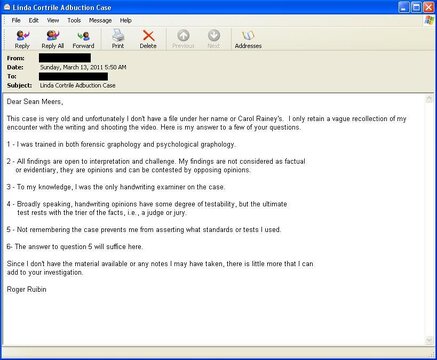
And Rubin does not stand by his “opinions” (as he describes his findings) with any real conviction today. Contacted by a member of my team, he replied in an email on March 12 that “this case is very old and unfortunately I don't have a file under her [Kimball's] name or Carol Rainey's. I only retain a vague recollection of my encounter with the writing and shooting the video…Not remembering the case prevents me from asserting what standards or tests I used.” He goes on to say that “All findings are open to interpretation and challenge. My findings are not considered as factual or evidentiary, they are opinions and can be contested by opposing opinions.”
There is a lot of conflating of identities here. Based on quotation marks one assumes one is listening to Mr Ledger's analysis - yet we slide into this paragraph that states that a 'member of my team' contacted Rubin - in the screen shot Sean Meers is being addressed.
Can someone unravel this for me? Sorry to be muddled - but the quoting is hard to follow. I guess this is suppose to be Budd Hopkins speaking - and Sean Meers is a 'member of his team'. It (seems) clear
from the above that Budd Hopkins is quoting an e-mail he says Sean Meers received from Rubin (though the quotation marks would indicate that Ledger is still speaking - oh well).
Sean Meers gives a screen shot of the e-mail in his link. However, all relevant identifiers are inked out so it is not provable who the e-mail is from. We are told it is from Rubin. You can read it as I've linked to it here. My initial read of the e-mail is not a concern. However, Budd Hopkins has reported the words in the e-mail in such a way that casts a question over Rubin's analysis. In fact, given the dicey nature of the content of the links, I am questioning whether Rubin actually wrote the e-mail.
Budd Hopkins continues -
All interested readers can examine for themselves the letters and numbers in Rainey's tape and check out the dissimilar details Mr. Rubin apparently overlooked. Also I have found in my files more handwriting by Janet Kimball which could help any future graphologist make a more accurate analysis of the similarities/dissimilarities in the writing. If need be, I will take these samples and the Kimball envelope to new experts, along with additional samples of Linda's writing.