
• NEW! LOWEST RATES EVER -- SUPPORT THE SHOW AND ENJOY THE VERY BEST PREMIUM PARACAST EXPERIENCE! Welcome to The Paracast+, 11 years young! For a low subscription fee, you can download the ad-free version of The Paracast and the exclusive, member-only, After The Paracast bonus podcast, featuring color commentary, exclusive interviews, the continuation of interviews that began on the main episode of The Paracast. We also offer lifetime memberships! Flash! Take advantage of our lowest rates ever! Act now! It's easier than ever to susbcribe! You can sign up right here!

    Subscribe to The Paracast Newsletter!

Voyager 1 One Light-Day Anniversary

Free episodes:

SRL+

Paranormal Adept
On September 5th 1977 Voyager 1 launched in reaching a speed of 38,000 mph. Forty-nine years and sixteen billion miles later the interstellar time capsule has achieved the one light-day anniversary. To give some context, the closest star other than our own Sun is Proxima Centauri located out there at 1,550 light-days, 4.25 light years, 1.3 parsecs or approximately 25 trillion miles. At its current rate of speed barring a multitude of potential calamities, Voyager 1 might reach that distance in 73,000 to 75,000 years. Then again, perhaps some space-faring civilization may intercept the craft, remove the gold disc with all the sounds of Earth and freak out while listening.
 
Then again, perhaps some space-faring civilization may intercept the craft, remove the gold disc with all the sounds of Earth and freak out while listening
Or come and hunt us down, isn't that what Hawking warmed would happen? The distances are truly hard to contemplate. To travel interstellar is to have some really kick ass tech. And you have to be a really different kind of life form. It seems absurd to physically travel from any other star system to here. But then all the cases of aliens here are absurd.
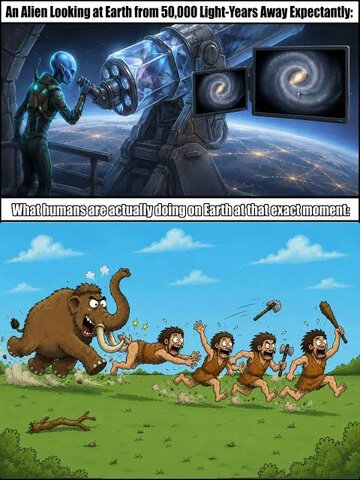
1795074608651.jpeg
Meanwhile our little rinky dunk satellite is floating out in space looking for someone with a gold record player. It's travelled one whole light day and that only took 50 years. Why hasn't AI already invented self replicating nanobots for us to traverse the galaxy with? The distances of time and technologies are outstanding. Still, I'm impressed with our fifty year journey.amd hope we continue to explore.
 
Or come and hunt us down, isn't that what Hawking warmed would happen? The distances are truly hard to contemplate. To travel interstellar is to have some really kick ass tech. And you have to be a really different kind of life form. It seems absurd to physically travel from any other star system to here. But then all the cases of aliens here are absurd.

Meanwhile our little rinky dunk satellite is floating out in space looking for someone with a gold record player. It's travelled one whole light day and that only took 50 years. Why hasn't AI already invented self replicating nanobots for us to traverse the galaxy with? The distances of time and technologies are outstanding. Still, I'm impressed with our fifty year journey.amd hope we continue to explore.
I think that curiosity would be the primary motivation for interstellar travel and less wanting to kick the asses of really stupid lifeforms on some podunk little planet.

Voyager is still one of the coolest things we have ever done. Let's hope it never becomes V'ger.
 
Or come and hunt us down, isn't that what Hawking warmed would happen?
Yes, however by that time we’ll be very, very dead.
Meanwhile our little rinky dunk satellite is floating out in space looking for someone with a gold record player.
Who knows, maybe something out there has a decent turntable with a decent cartridge with an album collection including “The Best of The Bee Gees”.

But hey, check this out:

  • Active power ends (2030s): Its plutonium-238 generators lose about 4 watts of power per year. NASA has been shutting down instruments (such as the Low-Energy Charged Particles experiment in April 2026) to conserve energy, and communication with Earth will likely end in the 2030s. [1, 2, 3]
  • Silent coasting (40,000+ years): Once power runs out, Voyager 1 will keep moving at roughly 17 km/s (over 61,000 km/h). In about 40,000 years, it will pass relatively close to the star Gliese 445. [1, 2]
  • Gradual erosion (billions to trillions of years): Without air resistance to slow it down, it faces only slow micro-erosion from interstellar dust, cosmic rays, and occasional micrometeoroids. There is a consensus on Reddit's askastronomy that this gradual erosion wears away only tiny amounts over vast spans of time, letting the spacecraft and its Golden Record persist for roughly 1 to 10 trillion years before breaking apart. Similarly, users on Quora agree that while its electronics degrade and its power fades within decades, its main structure will endure for billions of years
Chances are that by the time if any intelligent species discovered Voyager 1 the Earth will simply be a footnote in the cosmic record.

But looking on the brighter side, perhaps the known and observable universe is simply a cosmic hoax and Voyager 1 will smash into a wall such as Truman Burbank ran his sailboat into the sphere’s wall in the Truman Show in ending the show’s existence.
 
Back
Top